ERA vs. ERC

'17 Wheeler

For as long as kids have looked at the back of baseball cards, they’ve had a general understanding of ERA (Earned Run Average). If you look up the definition, the general consensus is “A measure of a pitcher’s performance by dividing the total earned runs allowed by the total of innings pitched and multiplying by nine”. My baseball education taught that it was earned runs multiplied by nine, divided by innings pitched but the numbers come out the same. The premise of the statistic was to not burden a pitcher with runs that had been enabled by errors or passed balls. In other words, eliminating from the calculation events that were out of his control.


If you’ve watched enough baseball to give the definition a personal “eye test”, you already know that numerous runs score in a game that don’t necessarily fit the criteria. If a pitcher leaves the game with the bases loaded (through hits & walks) and the relief pitcher gives up a triple, the original hurler just gave up three earned runs while he was sitting in the dugout. If there are runners on 2B & 3B with two outs and a weak groundball trickles under the glove of the shortstop into left field, two earned runs score whether the fielder in question was Pee Wee Reese or Pokey Reese. Outcomes like these are what motivate the development of advanced baseball statistics. One we’ve visited previously is DIPS (Defensive Independent ERA) and now there’s another stat for the research toolbox.


In an additional attempt to move beyond ERA, we now have a stat called ERC (Component ERA). The essential theory is that pitchers can only really control how they pitch, but not necessarily the outcomes. ERC estimates what a pitcher’s ERA should have been based on raw statistics. As a result, it might be able to tell us if pitchers were lucky or unlucky in a given season. You can find the ERC formula in the Bill James Handbook 2020 and the stats are also available at espn.com.


The question for those of us playing Fantasy Baseball is if the ERC numbers can assist in determining the value and predictability of pitchers. Many a team has been torpedoed by a couple of starting pitchers that didn’t perform to expectations and we’re always looking for an edge. As a 25+ year fantasy veteran has said many times, “I hate pitchers”. Just taking a superficial look at ERC results for 2019 reveals the following tidbits.


> For the season, eight major league starting pitchers had an ERA under 3.00, but amazingly, six of them actually pitched better than their base number led by Justin Verlander (2.58 ERA & 1.80 ERC). He was followed by Gerrit Cole, Zack Greinke, Max Scherzer, Sonny Gray & Jacob deGrom.  Hyun-Jin Ryu and Mike Soroka were the exceptions but even their ERC was less than 10% higher. These guys are solid contributors.


> The next dozen ERA leaders (under 3.60) show some interesting contrasts. #16 Dakota Hudson had the biggest negative gap (3.35 ERA / 4.40 ERC) followed by #11 Marcus Stroman (3.22 ERA / 3.74 ERA). The three hurlers whose stats should have been better are Stephen Strasburg (3.32 ERA / 2.64 ERC), Lucas Giolito (3.41 ERA / 2.76 ERC) and Walker Buehler (3.26 ERA / 2.66 ERC).


> Looking at the off-season free agent class, these analytic numbers must be important to GM’s. Zack Wheeler’s new contract is impressive but so is the breakdown of his 2019 performance…3.96 ERA, 3.60 ERC & 3.35 DIPS. Not so sure about the $18 Million Cole Hamels deal (3.81 ERA / 4.35 ERC). Madison Bumgarner may sign soon and his numbers should create optimism (3.90 ERA / 3.40 ERC). How would you feel about Dallas Keuchel (3.75 ERA / 4.62 ERC), Julio Teheran (3.81 ERA / 4.02 ERC) or Wade Miley (3.98 ERA / 4.19 ERC)?


> Expanding the category of  possible sleepers finds Yu Darvish (3.98 ERA / 3.36 ERC) and Joey Lucchesi (4.18 ERA / 3.48 ERC).


You’ll notice that Win-Loss records aren’t part of this analysis. Fantasy players have long understood the cruel category of “Wins” but the real game has begun to catch up. With starting pitchers going less innings and teams spending $8 Million on middle relievers, the concept of a 20-game winner is a thing of the past. In 2019, Verlander & Cole were the only ones to achieve that milestone. MLB teams are no longer concerned with starters going deep into games because they’ve got lock-down guys in the bullpen. What they want is quality innings.


As always, Fantasy success comes from balance, both on your team and in your scouting, so maybe ERC (and DIPS) has a place in your toolbox. And, the next time one of your baseball buddies asks how you are, you can reply, “I’m feeling much better now that I’m monitoring my ERC”.


Hanging Around The Hot Stove With Bill James

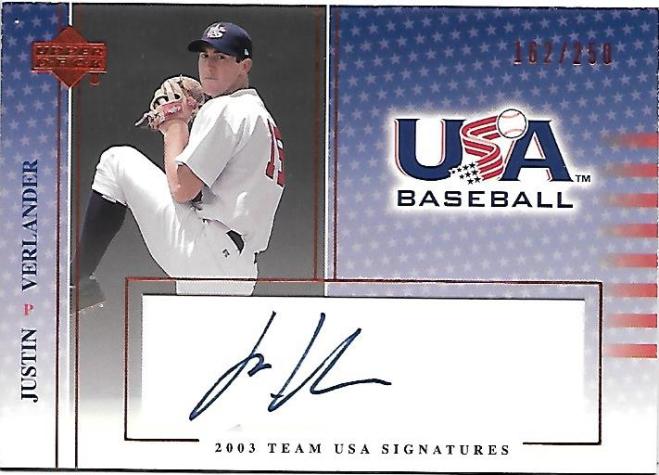
'03 Verlander

Many baseball fans from the “Baby Boomer” generation haven’t really bought into the immense change in how statistics are viewed. They still look at the game with their eyes and are only concerned with the numbers on the back of the baseball card. For those of us more immersed in the details of the game, the man who guided us through the wilderness is Bill James. Starting in the late 70’s, he published an annual “Baseball Abstract” that began the task of analyzing data in new and different ways. By 1985, he wrote the first “Historical Baseball Abstract” and that 700+ page volume still sits on the bookshelf in my office.


For baseball fans in general and Fantasy Baseball players who can’t wait for the upcoming season, Bill also helps us get through the winter while we’re longing for box scores. Each November, The Bill James Handbook gives us a review of the season, lifetime stats of every major league player and numerous articles and lists to make the “hot stove” season tolerable. The 2020 version is available now and at 632 pages, offers just about something for everyone. The Old Duck has an annual exercise, where I take my initial cursory glance at the book and begin discovering information that surprises and enlightens me.


So, here are some random observations from my first time through the pages…


> In golf and tennis, fans can easily find current rankings on each player. The systems are set up so that the rankings move up and down based on performance and are not just for the current season. James has developed a similar idea for ranking starting pitchers. The current top five are Justin Verlander, Gerrit Cole, Jacob deGrom, Max Scherzer and Stephen Strasburg. Cole & Strasburg were not in the top five when the 2019 season began but Chris Sale (who went from #4 to #7) & Corey Kluber (from #5 to #38) both fell victim to the injury bug. Some of the biggest drops since a year ago were Carlos Carrasco (from 10th to 40th), Blake Snell (#11 to #46) and German Marquez (#18 to #34). On the positive side, Jack Flaherty (72nd to 6th), Charlie Morton (34th to 13th), Sonny Gray (75th to 14th) and Lance Lynn (66th to 15th) were some of the shining stars.


> Fielding metrics are relatively new and not yet accepted by fans or even by many statisticians. The handbook’s “Defensive Runs Saved” chart does help us verify what we think we’re told by our eyes. Cody Bellinger ramped up his MVP credentials by leading all RF with 19 runs saved. Two CF topped that mark with Victor Robles at 22 and Lorenzo Cain with 20. No LF had more that 10. The 1B & 3B races were dominated by the A’s, as Matt Olson posted 13 while Matt Chapman had 18. Kolten Wong (14) was the 2B leader and at SS, Nick Ahmed just outdistanced Trevor Story (18 versus 17). Roberto Perez 29 runs saved led all Catchers. For all the cynical fans out there, we can’t leave out the worst fielders in the game and how many runs they cost their teams…


1B) Luke Voit & Pete Alonso -6 each

2B) Jonathan Villar -11

3B) Hunter Dozier -14

  1. SS) Xander Bogaerts (for the 2nd straight year) -21
  2. LF) Justin Upton -13 (in only 63 games)
  3. CF) Ian Desmond -19
  4. RF) Franmil Reyes -11
  5. C) Elias Diaz -23


> A consistently debated topic among fans and media is the dramatic increase in defensive shifts. In 2014, shifts were utilized over 13,000 times, in 2015 the number increased to over 17,000 and in 2016, it grew tremendously (+58%) to over 28,000. The 2017 numbers seem to show that the optimum advantage has been reached, as the figure dropped slightly to 26,700. But 2018 put every number in the rear-view mirror with over 34,600 (a 30% increase). 2019 left that number in the dust with a 34% increase to 46,700. To the naysayer, the question becomes, would teams be shifting if it didn’t work? According to the “Runs Saved” statistic, shifting saved 196 runs in 2014, 267 runs in 2015, 359 in 2016 and 346 in 2017. Then in 2018, it increased to 592! 2019 came in at 622 runs! The shift lowered the Batting Average of shift candidates by 32 points. 25 of the 30 teams increased their shift usage, so don’t expect the strategy to go away.


> In the past, players were judged as good baserunners if they swiped a lot of bases. Not only were their other baserunning skills not considered, even their caught stealing stats were ignored. However, as Tom Boswell pointed out over 20 years ago, a caught stealing is equivalent to two outs because it not only removes a baserunner, it also causes an out. Now we have information that tells us how often a player goes from 1st to 3rd or 2nd to home plate on a single. The handbook grades baserunning on the net amount of bases a player gains in a given season. The top six were Jonathan Villar (+43), Christian Yelich (+43), Mallex Smith (+42) Jarrod Dyson (+39), Ronald Acuna Jr. (+37) & Adalberto Mondesi(+37).  The D’Backs were the best baserunning team in the game at +122.


> How often did the top five starting pitchers use their fastball? The “Pitchers’ Repertoires” section will answer that question by telling you that it was 50% for Verlander, 54% for Cole, 49% for deGrom and 48% each for Scherzer & Strasburg. See a pattern here? Maybe the pitching philosophy of “Throw him the heater, Ricky” went out about the time of “Major League II”.


That’s just a taste of the information in this year’s edition and we haven’t even looked at the individual player stats. No wonder that “stathead” is now an accepted baseball term.


Sharing The Wins

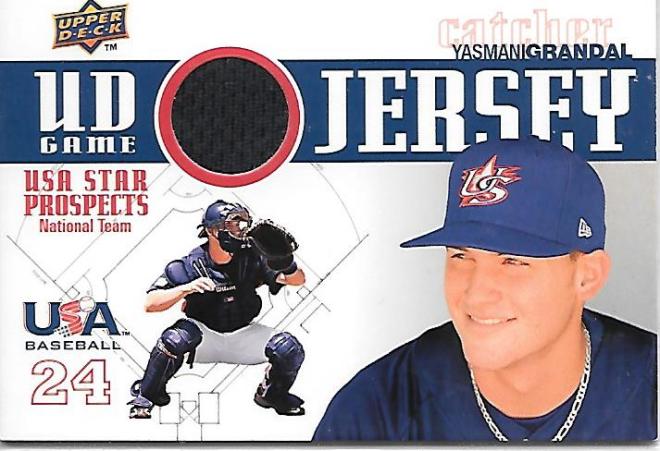
'09 Grandal

With the Winter Meetings on the horizon, let’s take a look at the relative value of the players in the game. In a sport awash with money, old-school fans often have difficulty wrapping their heads around the new levels of salaries and budgetary guidelines. With the average MLB salary now above $4 Million, how do we really know what a player’s contribution is worth? And do these contributions really make a difference in the standings?


In other words, what is their contribution to winning games? We’ve discussed WAR (Wins Above Replacement) numerous times in this space and that statistical outcome does impact decisions made by writers voting on awards and General Managers making deals. It has become a mainstream analysis over the last decade and can help clarify and justify some contract amounts. For example, if you believe in the WAR calculations, it confirms that Mike Trout was the best position player in the AL (8.6 WAR) and Cody Bellinger was tops in the NL (7.8 WAR). The fact that they each won the MVP adds to the credibility of the statistic. Cy Young Award winner Jacob deGrom (7.0 WAR) was the best in the NL while the AL winner Justin Verlander (6.4 WAR) was in the top four.


Most baseball stat-heads believe a player is worth about $6-8M per win to his team and free agent signings give us a window into that formula. So, when you digest the upcoming free agent contracts of Gerrit Cole (7.4), Stephen Starsburg (5.7) Hyun-Jin Ryu (4.7), Anthony Rendon (7.0), see how close the formula comes out compared to the real world. Yasmani Grandal’s WAR (5.2) just turned into $18+ Million for each of the next four years.


Each year at this time, we turn to another statistical measure in an attempt to gauge player value. The other stat that is team-result based is WS (Win Shares) as developed by the godfather of modern statistical analysis, Bill James. While trying to describe the formula is impossible (James wrote an entire book on the topic in 2002), it comes down to a system where each game a team wins during the season is meticulously analyzed and the three players most responsible for that win get a “win share”. So, if a team wins 80 games, there will be 240 win shares distributed on the roster. Position players will have a tendency to accumulate higher totals than pitchers, but it’s all about comparisons between players among positions. Only ninr position players had a number of 29 or better in 2019 and it’s difficult to take exception with the results Marcus Semien led the way with a figure of 36. Both MVP’s are on the list with Trout at 33 and Bellinger at 31. The other members of the elite nine are…


> Christian Yelich, 33

> DL LeMahieu, 33

> Alex Bregman, 31

> Anthony Rendon, 31

> Ketel Marte, 29

> Ozzie Albies, 29


The highest-rated Starting Pitchers were Verlander with 23, Cole with 22, deGrom & Zack Greinke with 21 each and Shane Beiber with 19.


As always, there are some hidden tidbits in the rankings that impact both fantasy and reality baseball…


> Rookies of the Year contributed impressively with Pete Alonso getting 24 and Yordan Alvarez coming in at 14 in less than a full season.


> In case you’re wondering which $300 Million deal paid off better, Bryce Harper’s 27 was significantly better than Manny Machado’s 18.


> Looking for upside? Yoan Moncada improved from 6-to-13-to-23 over the last three seasons… Gleyber Torres posted 28 after having 19 in his rookie season… Kolten Wong went from 12-to-24… Ronald Acuna Jr. improved to 28 from 19 as a rookie.


> What about 30 something player’s on long-term deals? Lorenzo Cain went from 25-to-11, Ian Desmond from 12-to-8, Robinson Cano from 18-to-7, Matt Carpenter from 28-to-11, Joey Votto from 22-to-11.


> Eric Hosmer posted 30 in 2017…since signing an 8-year deal, he’s dropped to 16 & 17 the first two seasons in San Diego


> Albert Pujols has accumulated 487 Win Shares in his career…his 2019 figure of 10 was actually better than either of the two previous seasons (7 & 8).


> Under the radar…Matt Chapman has 25 in each of the last two seasons and Jorge Polanco posted 26 in ’19.


> Alex Colome had more (12) than Kenley Jansen (10).


> Travis d’Arnaud (15) outperformed Buster Posey (12).


Don’t forget, it’s the season for sharing…All Holidays Matter!

Top Ten Baseball Cards Of The 1950’s

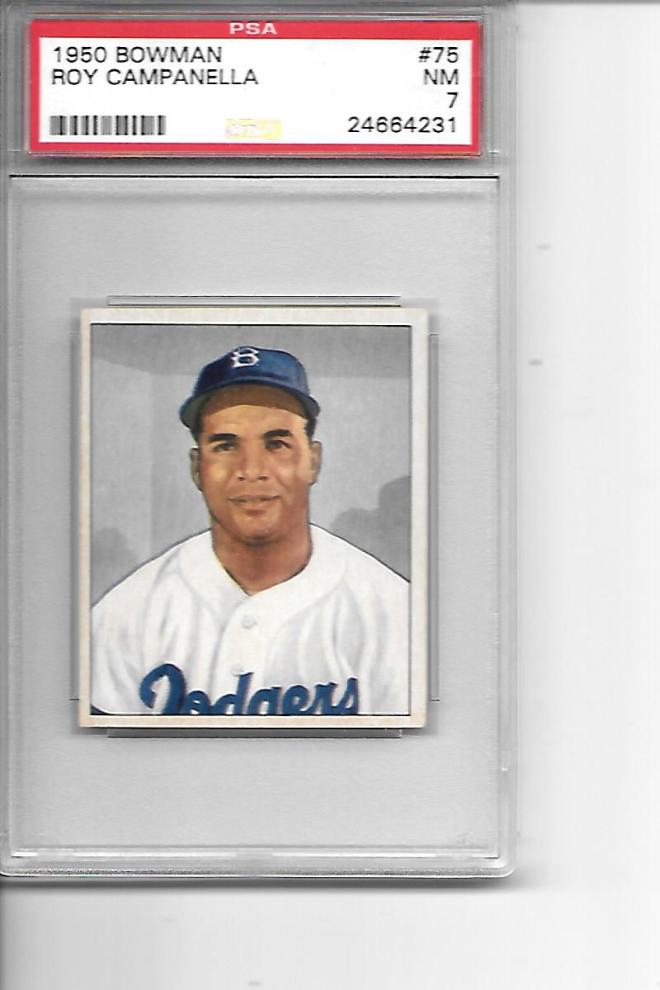
'50 Campy

A wise man once said, “Life is more worthwhile when you can be passionate about something trivial”. Certainly each of you who plays Fantasy Baseball understands that quote and so do those of us who collect baseball cards. A number of years ago, a vivid reminder of this thought process came to me in the form of an old binder.


In my community, we’re fortunate to have an extremely active sports interest group. The dedicated gentleman who organizes our activities is a retired teacher from the Bronx and when it comes to convincing sports figures to visit and speak to our group, he is what I would describe as a “bulldog”. Once he makes a contact with someone, they will be hounded until they understand clearly that the only respite from his pressure will be to show up at one of our meetings. This methodology has given us the privilege of having up close and personal connections with Hall of Famers like Fergie Jenkins & Roland Hemond as well as stars such as Josh Hamilton & Matt Williams. And, yes, I’ve even been “convinced” to create presentations on Baseball Card Collecting, Ted Williams & Autograph Collecting for our group.


About seven years ago, a member showed up at one of our meetings with a small binder and sought me out prior to the speaker being introduced. He had found out that I was a baseball card collector and memorabilia “expert”, so he brought something to share with me. In the plastic pages of this non-descript three-ring folder was a complete, 252-card set of 1950 Bowman baseball cards in beautiful condition. Honestly, the experience of looking at this rare set was incredible. Because the cards have no lettering on the front, the real fun is to look at the great pictures and try to see how many of the players you can recognize. The real privilege, however, is to hear the story from the collector. In 1950, he had a paper route and every week when he got paid, he would go to the store and buy packs of cards. Yes, these cards are his from over 65 years ago! This would be like someone pulling into your driveway in a 1950 Cadillac Series 61 Coupe that has only 10,000 miles on the odometer. Even if you don’t know that much about cards, think about the fact that this set came out two years before Topps was even in business!


To understand the significance of the ’50 Bowman set in terms of baseball history, here’s a Fantasy team you could field from the players represented in the set…


1B – Gil Hodges

3B – George Kell

1/3 – Johnny Mize

2B – Jackie Robinson

SS – Phil Rizzuto

2/S – Pee Wee Reese

C – Yogi Berra

C – Roy Campanella

OF – Ted Williams

OF – Duke Snider

OF – Larry Doby

OF – Ralph Kiner

OF – Richie Ashburn

DH – Ted Kluszewski

SP – Bob Feller

SP – Robin Roberts

SP – Bob Lemon

SP – Early Wynn

SP – Warren Spahn

RP – Jim Konstanty

RP – Mickey Harris


Konstanty & Harris were the 1950 league leaders in saves with 22 & 16 respectively.


This leads into one of those discussions where everyone has an opinion. Ask a baseball fan to name the all-time Outfield and they might list Ted Williams in LF, Willie Mays in CF and Babe Ruth in RF…leaving Mickey Mantle, Joe DiMaggio, Ty Cobb, Hank Aaron & Roberto Clemente on the bench. That still leaves two more spots on a top ten list. Who would you choose? Stan Musial, Duke Snider, Pete Rose, Tony Gwynn, Ken Griffey Jr. or ??? Not an easy choice, but a fun exercise.


Top tens are great for card collectors also. Your list might include your favorite player or the most expensive card, but everyone’s choices will be different. In honor of the ’50 Bowman set, we’ll start with that decade when the era of modern card collecting essentially began. Here’s the top ten of this baseball fan…


1) 1952 Topps Mickey Mantle (#311) – While technically not his rookie card, the ’52 Topps issue really set the stage for the next 65 years of card collecting. With Joe DiMaggio retiring after the ’51 season, Mantle became the face of baseball’s most storied franchise.


2) 1954 Bowman Ted Williams (#66) – The greatest hitter ever on a beautiful card would be enough, but scarcity is the key to this gem. Williams signed an exclusive contract with Topps in ’54 and threatened to sue Bowman when they issued this card without his permission. Bowman pulled the card from production and replaced it with one of Red Sox Outfielder Jim Piersall, so only a small amount of the Williams cards were issued.


3) 1950 Bowman Jackie Robinson (#22) – The most valuable card in this set, it pictures the man who changed the face of baseball forever.


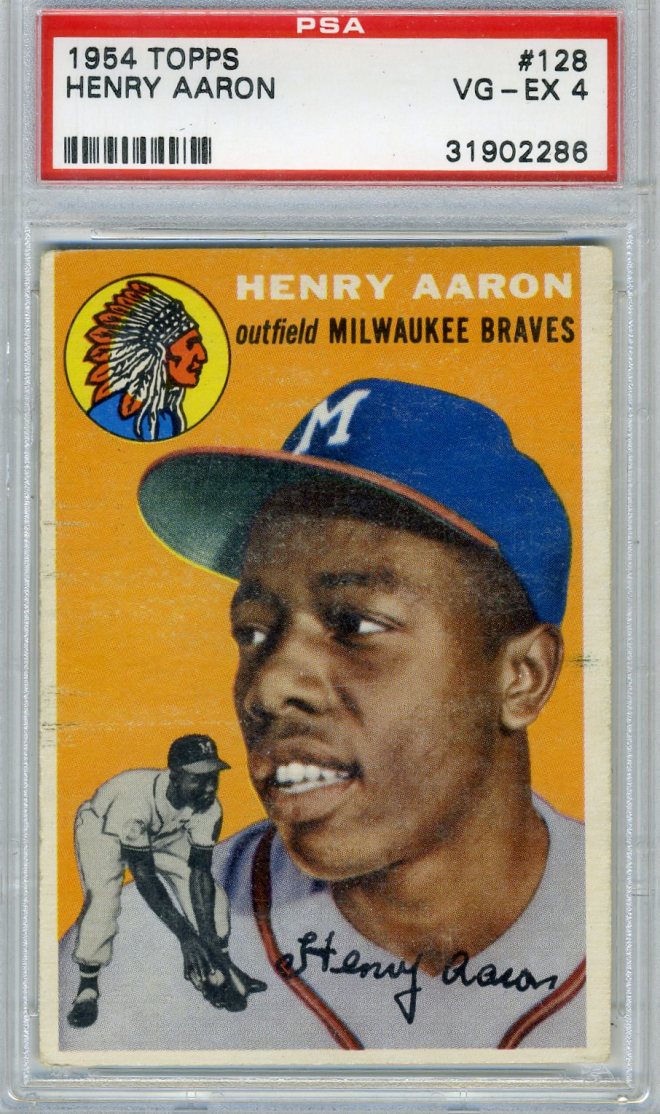
4) 1954 Topps Hank Aaron (#128) – The only recognized rookie card of “Hammering Hank’, the set features a double photo of the player on the front of the card.


5) 1951 Bowman Willie Mays (#305) – The rookie card of the “Say Hey Kid” and arguably the best all-around player in history, it has about the same value as his first Topps card in the iconic ’52 set.


6) 1956 Topps Mickey Mantle (#135) – Many collectors feel that the ’56 set was the most attractive ever and Mantle’s card embodies the set…it was his Triple Crown season.


7) 1955 Topps Roberto Clemente (#164) – The rookie card of the Latin legend was from the first Topps set to be presented in a horizontal format.


8) 1953 Topps Willie Mays (#244) – This classic set features drawings of the players (as opposed to actual photographs) and is unique in its visual appeal.


9) 1955 Topps Sandy Koufax (#123) – The other key rookie card from the ’55 set shows the Hall-of-Famer at age 19 and represents the only Pitcher on our list.


10) 1954 Topps Ted Williams (#’s 1 & 250) – To understand the stature of “Teddy Ballgame”, once Topps finally got him under contract, they made his cards both the first and last in the set.


Did I miss your favorite? Al Kaline & Ernie Banks rookie cards from ’54 Topps? Mantle’s rookie card from ’51 Bowman? Eddie Mathews rookie card from ’52 Topps? All good choices…who is in your top ten?


Say It Ain’t So Joe

Joe & Katie Jackson

Shoeless Joe Jackson is one the most famous – and infamous – baseball players in history. Growing up poor in rural North Carolina during the 1890’s, he started working in a textile factory at age 7 and never had any formal education. What he could do, however, was play baseball. He played for factory teams and semi-pro clubs until 1908, when he became a professional with the Greenville franchise of the Carolina Association. By age 20, he was a star and led the league with a batting average of .346.


The Philadelphia Athletics signed Joe and he won minor league batting titles the next two years…at Savannah in 1909 and New Orleans in 1910, but A’s Manager Connie Mack didn’t think the shy, illiterate boy would be able to adapt to the big city of Philadelphia and traded him to the Cleveland Naps. As a rookie in 1911, he took baseball by storm by hitting .408 with 233 Hits, 45 Doubles and 19 Triples. He spent four seasons in Cleveland, was traded to the Chicago White Sox in 1915 and continued to play at the highest level, hitting .340 or better in four of the next five seasons.


The turning point for Jackson was in 1919 when the ChiSox won 88 games to capture the AL pennant with an opportunity to face the Cincinnati Reds in the World Series. Players on the team, fed up with the owner’s reluctance to pay them fairly, concocted a plan to go in with gamblers and fix the World Series. You can learn the whole story by watching the superb 1988 film, “Eight Men Out”. Chicago lost the best-of-nine game series 5 – 3.


Rumors were everywhere during the 1920 season, but despite the cloud of suspicion, Jackson had an amazing year…hitting .382 and leading the league with 20 Triples. The eight players involved eventually went to trial and were acquitted by the jury, but Baseball Commissioner Kenesaw Mountain Landis expelled all the players for life. It was the sad end of Shoeless Joe’s career.


In the late 1940’s, a young sports fan decided to build an autograph collection. The process was simple, but effective, as he would send a self-addressed post card in an envelope with a note to the player (or team) asking them to sign the postcard and mail it back. In the days before eBay, auction houses and the marketing of autographs, athletes were happy to fill the request. The youngster would cut out the signature portion of the returned post card and tape it an album along with pictures and articles of the players. As he grew up, the collection began to include many signatures acquired in person at games and other events. The end result was a collection that included thousands of autographs from ballplayers of multiple generations.


That young boy from the 40’s passed away earlier this year and the two stories intersected recently when his Wife asked me to assist in appraising – and eventually selling – autographs from the collection. The starting point were three binders from the beginning of the project that were completely disorganized…torn newspaper clippings, discolored tape, little loose remnants of 70 year-old post cards with signatures of long-forgotten athletes. Looking through the first binder, however, caused this old baseball fan to stop and stare. In my hands were the signatures of Hall of Famers such as Pepper Martin, Carl Hubbell, Paul Waner & others. Were they in nice condition? Absolutely not! Were they genuine? Even though independent authentication will be necessary, there is no doubt that they’re real.


By the time I opened the second binder, it felt like a treasure hunt as Rube Marquard, Harry Caray & Zack Wheat appeared. As the next page turned, could this be true? Was this really an autograph of Shoeless Joe Jackson? My expectations were tempered by the history of the player. He was, of course, illiterate and in a famous scene from the movie, Jackson (portrayed by D.B. Sweeney) signs a government document with an “X”. On the flip side, it must have come from Jackson, as the post card was still intact and dated (1951). Checking with an authentication expert gave me the answer…yes, it did come from Shoeless Joe but it was signed by his Wife!


15 year-old Katie Wynn wed Joe Jackson in 1908 and they were married until he passed away in 1951. According to history, Joe only signed legal documents and did it in a painstaking manner by tracing the signature. As the years went by, Katie would answer the requests of fans by signing Joe’s name for him. So, instead of a five-figure autograph of Shoeless Joe, we have a memento from Katie Jackson. The good news, however, is that the third binder yielded autographs from Cy Young & Ty Cobb.


Baseball history before our eyes.

Vintage Rookie Cards 1959-1980

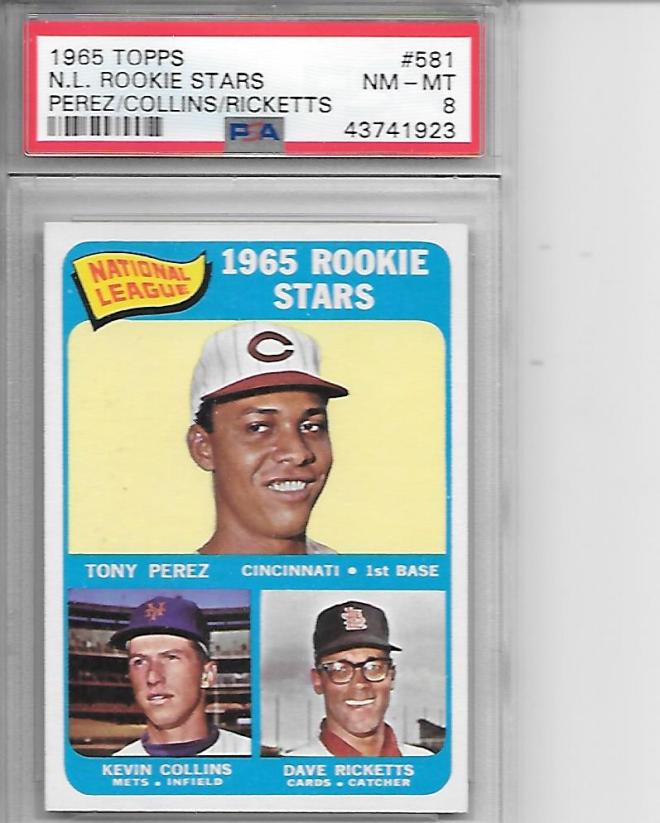
'65 Perez Mary


In 1959, Topps expanded their baseball card set to 572 cards and produced them in series. So when you purchased a pack early in the year, the cards would only be numbered 1-110 and as the year went on, other series would be offered for sale. At the time, it seemed logical, but for collectors of Topps cards from 1959-1973, it represented a challenge…and still does today. The later series were marketed late in the season when interest had waned and the cards became more scarce. So, when you hear a collector talk about “high numbers” being difficult to find, you understand the issue.


How this relates to “rookie cards” begins with that beautiful ’59 set. The best rookie card that year was future Hall of Famer Bob Gibson and his card was in the high number series (#514)…making it a tough card to find, especially in nice condition. In addition, all the All-Star cards were also in the high number run, creating another difficult collecting challenge that included Mickey Mantle, Willie Mays & Hank Aaron.


As the calendar turned to the 60’s, many great players made their debut and their rookie cards were (and still are) in great demand. In 1960, there was Carl Yastrzemski & Willie McCovey…1961 had Juan Marichal & Billy Williams…and in ’62, it was Lou Brock, Gaylord Perry and “Mr. Baseball” Bob Uecker.


The 1963 Topps set included a concept where many of the rookies were shown together on cards that had small, cropped photos of four different players…and some were in the high series. That is where you’ll find the rookie card of Pete Rose…shown with Pedro Gonzalez, Ken McMullen & Al Weis. While not very visually appealing, still a valuable card indeed. Willie Stargell’s rookie card is also in this category and includes three more obscure players.

The ’64 set has Phil Niekro and two famous Managers inTony LaRussa & Lou Piniella as well as a medical miracle in Tommy John. Lots of Hall of Famers in ’65 with Steve Carlton, Joe Morgan, “Catfish” Hunter & Tony Perez…’66 included three HOF hurlers with Jim Palmer, Fergie Jenkins & Don Sutton. Tom Seaver & Rod Carew both debuted in the high number series of the ’67 set.


The 1968 set features the rookie cards of two of the most popular players of the era…Nolan Ryan & Johnny Bench. Once again, Topps included multiple rookies on certain cards, so Ryan shares his cardboard with Jerry Koosman, while Bench is shown with Ron Tomkins. Finishing off the decade, Reggie Jackson & Rollie Fingers grace the ’69 set with their rookie cards.


In 1970, Topps issued their largest set ever at 720 cards in six series. The key rookie card in the set was that of the Yankee Captain, Thurman Munson. Interestingly, however, the 3rd year Nolan Ryan card is twice as valuable because it was part of the scarce high number run.


The 1971 set was even larger at 752 cards and remains a distinct challenge to collectors even today for one primary reason…the cards had black borders. So, even the most careful of handling couldn’t prevent excessive wear and finding 71’s in nice condition is very difficult. The key rookie cards are the Dusty Baker / Don Baylor in the high number series, Steve Garvey & HOF Pitcher Bert Blyleven.


In 1972, the Topps set expanded once again…this time to 787 cards. Carlton Fisk (who shares the card with Cecil Cooper) is the key rookie card. 1973 found the set reduced to 660 cards (five series of 132) and includes one of the best rookie cards of the decade in Phillie great Mike Schmidt. As with other years, this particular card was in the high series and Schmidt shared the card with two other players.


660 cards remained the standard from 1974-1977 and cards were no longer issued in series, making it easier for the collector to put together a set. Great rookie cards were found during that time including Dave Winfield in ’74. George Brett, Robin Yount, Jim Rice & Gary Carter were all in the ’75 set…Dennis Eckersley in ’76…and Andre Dawson in ’77 along with Mark Fidrych.


Topps went to 726 cards for 1978 and that remained in place for the next four years. The ’78 set featured the rookie card of Eddie Murray and a combo rookie card including both Paul Molitor & Alan Trammell. 1979 finished off the decade with the rookie card of the “Wizard”…Cardinals legend Ozzie Smith.


We’ll include the 1980 set in our review, as it was the final year of the Topps monopoly. Rickey Henderson’s RC highlighted the product and is still very desirable today.


Hope some of your favorites are included…


Baseball Card Collecting : The Rookie Cards

'54 Aaron

Somewhere during the evolution of the baseball card, collectors determined that the first card of a great player had more demand and enhanced value. So, the “rookie card” became the standard for the hobby and remains that way today. Fans will chase these cards and in today’s marketplace, with scouting and resources going down to the High School level, everyone is looking for the first card of the next superstar. A case in point is Bryce Harper, the phenom who was the #1 pick in the amateur draft of June 2010 by the Washington Nationals. In addition to his record contract, he also had a deal in place with Topps and baseball cards with his image were available for sale before he ever had a professional at-bat.


Looking back, you will see that the “rookie cards” in a particular issue have great significance on the value and staying power of those sets. The Goudey company made cards in the 1930’s and the 1936 issue includes the RC of Joe DiMaggio. The Play Ball company made baseball cards in the three years prior to World War II and even though over 75 years have passed, their 1939 set is still cherished because it included the rookie card of  Ted Williams.  The Yankee Clipper and the Splendid Splinter…aka Joltin’ Joe & Teddy Ballgame.


The 1952 Topps set includes the “holy grail” of modern baseball cards…#311, Mickey Mantle. Even though it is the most iconic card of the era, Mantle’s first Topps card is technically not his rookie card, as there was a Mantle card issued in the 1951 Bowman set. However, the history of that initial Topps offering makes the ’52 Topps Mantle worth 3-4 times more than the ’51 Bowman. Another Hall of Famer had his rookie card in the ’52 issue…Braves 3B Eddie Mathews. The Mathews card is very rare in good condition because it was the last card in the set (#407). Why should that matter? Because kids of that era didn’t have protective pages, sleeves and albums for their cards, so they would hold them together with a rubber band…and the Mathews card always took the abuse of being the bottom card. That is also why the #1 card, of an obscure player named Andy Pafko, is also very difficult to find in good condition.


The 1954 Topps set was another historical landmark, as it included the rookie cards of four Hall of Famer members…Hank Aaron, Ernie Banks, Al Kaline and Tommy Lasorda. The 1955 Topps set didn’t disappoint collectors with the rookie cards of Roberto Clemente, Sandy Koufax and Harmon Killebrew. Other sets of the 50’s has some unique stories also…in the 1957 Topps set, you’ll find the rookie cards of both Robinsons…Frank & Brooks, who teamed up later in their careers with the Orioles. Topps offered up the rookie card of Roger Maris in their 1958 set, while the 1959 collection featured the rookie card of Bob Gibson.


The November issue of Beckett’s Baseball Price Guide chose the ten cards of the last 50 years that had the most impact on the hobby. #1 on their list is Mike Trout’s Rookie Card from 2011 Topps Update.  After nine seasons of incredible performance, his accomplishments my be taken for granted but this is a generational player. Even though his RC isn’t really scarce, an ungraded one in Near Mint (NM) condition currently books for $300+.


Other RC’s in the top ten include Ken Griffey’s card from 1989 Upper Deck, the Albert Pujols autograph card from 2001 Bowman Chrome, Don Mattingly’s Donruss card from 1984 and the Derek Jeter Foil RC from 1993 SP. If you’re just getting started, the 2018 RC’s to look for are Ronald Acuna Jr. & Juan Soto…for ’19, it’s Vladimir Guerrero Jr., Fernando Tatis Jr. & Pete Alonso.


Hopefully, your baseball card collection is filled with prospects, not suspects.

Unexpected WAR

'19 Semien

Baseball fans and Fantasy Baseball Managers love pleasant surprises. Those players who weren’t on the radar in March and then turned out to be a very productive asset to your team.


They could fall into a number of categories. There are prospects who exceeded their ranking in the organization. Then there are those acquired in some insignificant trade who emerge with their new team. Or a post-hype player who disappointed in his first season or two and then figured it out. Every season, these players make a difference in the success of MLB teams and 2019 is no exception. We’re not talking about established guys like Cody Bellinger or Alex Bregman who took their game to another level or top prospects such as Victor Robles or Vladimir Guerrero Jr.


To identify the best of these, we’ll once again rely on “Wins Above Replacement” (WAR) which is a statistic designed to answer the following question…if this player got injured and their team had to replace them with an available minor leaguer or a AAAA player from their bench, how much value would the team be losing? The value is expressed in a wins format, so we can compare each player’s actual value.


According to the rankings provided by Fan Graphs, there were about 65 position players who provided at least 3 Wins to their team with Mike Trout leading the way at 8.6. In that top 65, we’ve identified a dozen who would certainly qualify as a pleasant surprise. Let’s take a look at the list with their overall ranking and WAR contribution…


> #5 Marcus Semien, Athletics (7.6 WAR) – Had a nice year in 2018 with a 4+ WAR, but this year in his 5th season as the A’s SS, his performance was off the charts. 33 HR’s, 92 RBI’s, 10 SB and a .892 OPS.


> #6 Ketel Marte, D’Backs (7.1 WAR) – His age 25 season was like nothing we’d seen before. 32 HR’s, 92 RBI’s 10 SB and an increase in OPS from .768 in ’18 to .961 in ’19. And he played multiple positions!


> #12 Rafael Devers, Red Sox (5.9 WAR) – At age 22, in his second full big league season, this 3B became a star. 32 HR’s, 115 RBI’s, a .916 OPS and he improved his BA from .240 to .311.


> #16 Yoan Moncada, White Sox (5.7 WAR) – The perfect example of a post-hype breakout, this former #1 prospect finally fulfilled the expectation. Cut down his strikeout total by 40% and contributed 25 HR’s, 79 RBI’s, 10 SB’s and a .915 OPS.


> #18 D.J. LeMahieu, Yankees (5.4) WAR – A really curious free agent signing because there wasn’t anywhere for him to play, turned into a coup for the Bronx Bombers. Playing all over the diamond, he provided an All-Star season. 26 HR’s, 102 RBI’s and a .893 OPS made him a bargain.


> #21 Pete Alonso, Mets (4.8 WAR) – A valued prospect but no one expected this kind of season. A new major league record for HR’s by a rookie with 53, he also added 120 RBI’s and a .961 OPS.


> #36 Jorge Polanco, Twins (4.0 WAR) – When a player gets an 80-game suspension for PED’s, you temper your expectation for the following season. Stats like 22 HR’s, 79 RBI’s and a .841 OPS from the SS position certainly helped the Twinkies to a post-season berth.


> #37 Austin Meadows, Rays (4.0 WAR) – The former Pirates prospect got the chance to play everyday and became an All-Star at age 24. 33 HR’s, 89 RBI’s , 12 SB’s and a .922 OPS foresees a bright future.


> #46 Jorge Soler, Royals (3.6 WAR) – Came to KC from the Cubs in 2017, but injuries seemed to hold him back creating a general consensus that his prospect rating was overdone. That all changed in ’19, as he played all 162 games, hit 48 HR’s and contributed 117 RBI’s.


> #50 Christian Vazquez, Red Sox (3.5 WAR) – Had been a part-time Catcher in Beantown for the last four seasons, hitting just .207 in ’18. This year, everything changed  as he became the full-time backstop and contributed 23HR’s, 72 RBI’s and a .276 BA.


> #52 Tim Anderson, White Sox (3.5 WAR) – Three seasons with the Pale Hose had been fairly disappointing and his 2018 BA of .240 was the low point. This season , he cut down the K’s significantly and ended up winning the AL batting title at .335.


> #60 Bryan Reynolds, Pirates (3.2 WAR) – Not considered a top prospect in the Buccos organization, he came up in late-April, started hitting and never stopped. A rookie season of 16 HR’s, 68 RBI’s, a .314 BA and a .880 OPS makes him look like a mainstay moving forward.


On the pitching side, surprises included Lance Lynn at #3 (6.8 WAR), Lucas Giolito at #10 (5.1 WAR) & Sonny Gray at #18 (4.4 WAR).


If you had these 15 players on your Fantasy squad, congratulations on winning the championship.

Getting My Dux In A Row

xfllogo

In 30+ years of playing auction-style Fantasy Baseball, winning over 30 championships can make you feel like an “expert”. The real test, however, is when you compete in a league full of experts. That has been a yearly challenge for The Old Duck and it presented itself once again as the 15 owners in the Xperts Fantasy League (XFL) gathered in Phoenix last week for their 18th annual draft.


As a quick refresher, the XFL is the only experts keeper league within the fantasy industry and many of the owner’s names are familiar to those who have viewed the landscape of fantasy sports over the years. These brilliant guys produce websites, magazines, newsletters and blogs that help guide you in becoming a better player in your league. The league is a 5 X 5 format (with on-base percentage replacing batting average), a 23-player live auction draft in October with a $260 budget and a supplemental snake draft in late March to round out the 40-man rosters (23 players are active each week during the season). Donald’s Dux (my squad) has captured four championships and holds the top overall performance record encompassing all 17 seasons of the league.


After finishing 1st, 1st, 2nd & 2nd from 2011-14, the Dux  struggled with 7th place finishes in 2015-16 and then a more respectable 5th place in ’17. The 2018 season, however, was a disaster and the Dux finished 11th. The 2019 season didn’t look too promising as the projections had the squad in the middle of the pack but the boys overachieved and finished a strong 3rd while actually contending for the top spot during the Summer. Solid seasons from long-time team members such as Jose Abreu, Yasiel Puig & Yoan Moncada helped the cause as well as the spectacular rookie campaign of Pete Alonso, a great sophomore performance by Gleyber Torres and a healthy year for Stephen Strasburg.


So, as we approached the October Draft for the 2020 season, it appeared that the Dux had a much better starting point than last year.


Here’s the keeper list that was frozen on October 4th –


C – Willson Contreras $13

C – Tom Murphy $6

1B – Jose Abreu $19

3B – Yoan Moncada $10

1/3 – Pete Alonso $4

2B – Eduardo Escobar $15

SS – Gleyber Torres $7

2/S –

OF – Yasiel Puig $19

OF – Niko Goodrum $6

OF –

OF –

OF –

U –

P – Patrick Corbin $13

P – Brandon Woodruff $11

P – Sandy Alcantara $6

P – Alex Colome $6

P –

P –

P –

P –

P –

P –

P –

Farm – Royce Lewis

Farm – Christian Pache


Here’s a quick review of the salary structure…


> October Draft – Player salaries are determined by the winning bid at the table and increase $5 each season. So, unless a team finds a break-out player in the end-game, there’s a reasonable chance that expensive veterans will only be on your team for one season.


> March Supplemental Draft – A 17-round snake draft gets all the squads up to a 40-man roster from which you determine 23 active players each week. All players chosen in this phase have a $1 salary. For current major-leaguers, the increase each season is $5 so the annual keeper lists have a smattering of $6 players that were great choices the previous year. Examples this time around include Sonny Gray, Kolten Wong, Domingo German, Marcus Semien, Jorge Soler & Adam Frazier . Minor-leaguers taken in this phase also have a $1 starting salary, but once they get to “the show”, their salary only goes up $3 per year. This is what might be described as the “dynasty” component in this particular league. An example would be Jose Abreu, who was taken as a free agent by my team in March of 2014 and now enters his 7th season on the roster at a salary of $19.


> In-Season Monthly Free Agent Selections – Teams can choose free agents once a month and drop someone on their roster in a corresponding move. The salary is $5 with a $5 increase in subsequent seasons, so you’ll see a few of these players scattered on keeper rosters at $10 each year. Current examples include Taylor Rogers, Christian Walker, Lucas Giolito, Jake Odorizzi & Bryan Reynolds.


The nine hitters on the keeper list had a salary total of $102, while the four pitchers equaled $36 leaving $122 to buy 10 players at the draft table. The basic allocation would be $67 for the five hitters and $55 for the five pitchers. So, the draft strategy was as follows…


> Spend $15+ to fill the 2/S spot and prioritize speed…someone like Andrus, Segura or Newman.


> Allocate $45-$50 for three OF’s who are solid everyday players…or overpay for the first two (Conforto, Castellanos, Schwarber, et al) and find an overlooked player for the 3rd spot (Hicks, Margot, etc.)


> Look for one of those end-gamers in the Utility spot that could be productive…Winker, Cooper, Hays & Grichuk come to mind.


> Three starting pitchers for about $40…Strasburg ($35 salary) wasn’t kept because the money needed to be spread around. Hurlers like Wheeler, Bumgarner, Ray & Musgrove are on the radar.


> Spend $12-$15 on a 2nd Closer…the priority is just finding someone who will have the job in March. Iglesias, Osuna & Neris all fill the bill


> Look for skills in the last pitching spot for a minimal cost…Lugo, Jimenez, Leclerc and others.


> My advice to players has always been to not “chase” any particular player. Find a group of players that fit your need and focus on getting one of them. This was the biggest challenge because so many of MLB’s star players were already rostered.


Before reviewing the results of the draft, there’s one other important league rule for readers to understand. Even though the word “list” is being used in this discussion, the really unique aspect of the XFL is that team owners can bring nothing to the table…no lists, no projections, no research, no draft software, no laptops, no tablets and no smart phones. When you sit down at the table, major league depth charts are handed out with the names of keepers crossed off and that is your only reference material during the auction. Even the depth charts are as neutral as possible with players listed by position and alphabetically. You don’t get any help as the typical MLB team could have 12 relief pitchers on the sheet and you need to know which one might get (or be next in line for) Saves.


The actual approach at the draft table needed to be somewhat aggressive for the positions needed because 1/3 & C were already filled. And, of course, never forget the words of a world-class poker player who once told me, “If you sit down at the table and don’t spot the pigeon, it just might be you”.


One of the keys in a keeper league environment is to  determine what the inflation factor might be on player salaries. You can do the math prior to the Draft, but until you actually hear the bids, you can’t really be sure. Every Fantasy league is basing their valuations on projections but when you’re bidding in October, knowing what a player actually “earned” the previous season can give some insight into inflation.


The first player nominated might tell us some of what we wanted to know. The last two seasons, J.D. Martinez went for $50+ at the table and ended up earning $26 for 2019 in our statistical format. This time, he was bought for $34, which only represented a 30% inflation factor. Did that mean the inflation factor was going to be less than usual?


That question was answered when Joey Gallo was the 2nd players off the board at $37. Even accounting for injury time, this seems to be about a 100% inflation factor. The 3rd player was Chris Sale at $29 and he only earned $8 in an injury plagued season, so that inflation factor would certainly be 50%+. The answer was now clear…inflation would be traditionally high and overpaying for assets in the early rounds would be necessary.


The next eight players told the tale…Charlie Blackmon ended up costing $32 (60% inflation), Stephen Strasburg $38 (40%), Jose Altuve $34 (100%), Paul Goldschmidt $30 (58%), Clayton Kershaw $30 (30%), Zack Greinke $31 (7%), James Paxton $23 (130%) & J.T. Realmuto $31 (107%).


The only “bargain” in Round 1 seemed to be Hyun-Jin Ryu, who sold for $18 despite earning $27 in 2019.


The Dux didn’t roster a player until the 5th pick in Round 2, when we added Madison Bumgarner for $14. Despite the perception that his 9-9 season was mediocre, he earned $13, pitched 200+ innings and recorded 200+ K’s.


In the middle of the 2nd Round, we brought up Andrus and were will to pay $18-$20 based on our budget. The bidding seemed to stall at around $17, but then picked up again, driving the final price to $24. The Dux dropped out at $20. The plan was then to bring up Newman at our next opportunity but Segura was nominated in the interim, so we took him for $13. Not the base-stealer he once was, he still contributes double-digit HR’s & SB’s while hitting in a strong line-up.


Now it was time to get that Closer and Rasiel Iglesias was the choice at $16. Quality Closers in this league go for $12-$18 and it is always a roll of the dice. His record of 3-12 was ugly but 34 Saves and a K/9 of 12 says the stuff is still solid.


The rest of the picks were unexciting but balanced. $48 was allocated for three OF’s and we added Manny Margot, Kyle Schwarber & Brandon Nimmo for a total of exactly $48. $40 was set aside for three SP’s and Bumgarner, Miles Mikolas & Joe Musgrove only cost $33, allowing us to add another SP in Stephen Matz. The Utility spot was filled by Garrett Cooper, who qualifies at both 1B & OF.


The Dux spent $169 on offense (65% of budget) and $91 on pitching (35% of budget), which were the exact target numbers….and we didn’t leave any money on the table.


Just to keep your mind percolating during the off-season, here are some random thoughts from the Draft…


> October is much too early to evaluate injured pitchers…Nathan Eovaldi went for $1, as did Lance McCullers, Aaron Sanchez, Michael Pineda & Alex Wood.


> Reputations don’t matter as future Hall of Famers Miguel Cabrera and Albert Pujols weren’t drafted.


> Never ask the question, “why did someone pay $30 for Frankie Montas” without clearly understanding that someone else bid $29.


> And, of course, the annual exercise of listing the players that weren’t even drafted. You can decide if the experts were right or wrong…Anthony Santander, Jackie Bradley Jr., Rick Porcello, Yolmer Sanchez, Leury Garcia, Christian Stewart, Josh Reddick, Wade Miley, Nicky Lopez, Alex Gordon, C.J. Cron, J.A. Happ, Mike Fiers, J.P. Crawford, Domingo Santana, Rougned Odor, Hunter Pence, Justin Smoak, Teoscar Hernandez, Nick Ahmed, Mike Leake, Julio Teheran, Mark Melancon, Jason Heyward, Jose Quintana, Jose Peraza, Ian Desmond, Kiki Hernandez, Starlin Castro, Eric Thames, Orlando Arcia, Ryan Braun, Todd Frazier, Cesar Hernandez, Maikel Franco, Colin Moran, Chris Archer, Dexter Fowler, Brandon Belt, Evan Longoria, Brandon Crawford, Kevin Pillar & Ryan Zimmerman.


You can review additional league information at fantasyxperts.com


The Baseball Card Version Of Cheers

AZSC

When you’re fortunate enough to retire, here’s some advice…keep busy and do stuff you love. It may sound simple but a number of my friends who haven’t retired yet always seem to wonder, “What will I do”. The answer for me a dozen or so years ago was to immerse myself in the game I love…baseball.  From Spring Training to Fantasy Baseball leagues to the Arizona Fall League, to a community sports interest group, it was an easy transition.


Then, I luckily stumbled across the idea of dealing with baseball card collections. At that point, no one would have considered me an expert, but it is amazing how good your study habits can be when you’re motivated. I became a regular customer at a North Phoenix baseball card shop, printed up some business cards (Rotisserie Duck Baseball Cards) and started advertising on free websites. After acquiring a few small collections and utilizing some cards from my personal stash, I became an eBay dealer. There were many mistakes along the way but the end result has been over 10,000 sales through the years with a 100% positive customer feedback rating.


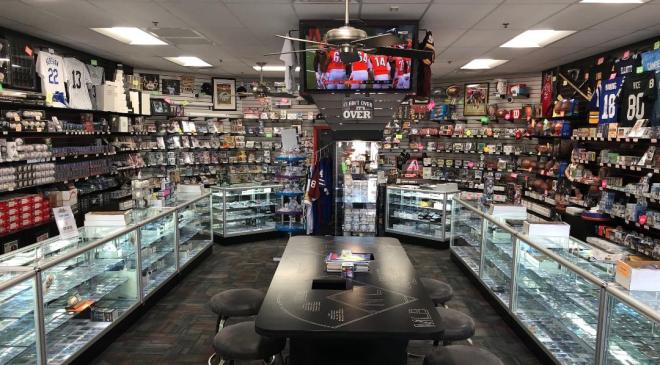
The other positive outcome from this experience has been a valued friendship with a great guy I met at that original card shop. We obviously had a mutual interest in collectibles and it evolved into endless talks about sports over lunch, rounds of golf and dinners where his lovely wife would put up with our sports-related conversation.  3 1/2 years ago, fate intervened and another local baseball card store became available due to the untimely passing of the owner. My friend jumped into the void and negotiated a purchase with the family of the owner. Almost everyday prior to the deal being finalized, he would say, “You’re going to help me with the store, right?” The purchase got done and it has been an unbelievably wonderful experience. Two days a week, I set up my “office” behind one of the counters and people make appointments to bring in their collections. The results have certainly been positive for us financially, but it is so much more than that. My friend is meticulous about continually upgrading the look of the store (his background is in retail space construction) and the atmosphere is incredible. Customers describe it as a baseball card version of “Cheers” with bar stools, island seating, counter space, sports events on TV, etc. Due to my continuous pontificating about baseball, I’ve acquired multiple nicknames including, “Senior Buyer”, “OG” (Original Google) and “Don Cardleone”, who will make you an offer you can’t refuse. Can you imagine a better way to spend your time in retirement?


As a public service, here’s the latest version of Card Collecting 101…


Baseball fans fall into categories – 1) card collectors…2) former card collectors…3) wannabe card collectors…4) or as George Carlin once said, “Grow up, these are just pictures of grown men”. For those of you in the first three groups, maybe a primer on the basics of collecting would enhance your experience or motivate you to get back into the hobby. For this exercise, we’ll stick to new products as opposed to secondary markets that sell older cards.


  1. Where do I buy cards?
  2. Card shops, hobby stores, retail chains and Internet dealers.


  1. Are the products from these outlets all the same?
  2. No, there are “Hobby” packs and “Retail” packs. A hobby pack will have more autograph, memorabilia and insert cards…and will have a higher price.


  1. Huh, what are autograph, memorabilia and insert cards?
  2. When the card manufacturers re-invented themselves about 20 years ago, they created interest in new products by inserting cards autographed by players or including a piece of memorabilia in the card (jersey, bat, etc.). Insert cards include parallel versions of the regular card or a special set highlighting certain players.


  1. Can cards be purchased directly from card companies?
  2. Yes…some manufacturers sell on their websites, but the pricing will be comparable to other outlets


  1. What is the configuration of today’s cards?
  2. Baseball cards still come in packs which have a certain number of cards (depending on the product). A sealed box of cards will include a specific number of packs. For example, the Topps Heritage brand arrives from the factory is a case of 12 boxes, each box has 24 packs, each pack has 8 cards.


  1. What size are cards?
  2. Today’s standard is 2.5 inches by 3.5 inches.


  1. What is a rookie card?
  2. Usually, the first regular issue card of a player in his major league uniform.


  1. What is a short-print card?
  2. This goes back all the way to the 50’s and is a card made in smaller quantities than others. Again, using Topps Heritage as an example, the 500 card set has #’s 426-500 made in lesser quantities.


  1. Sometimes when I open a pack, there’s a blank card inserted – why is that done?
  2. Companies insert them to discourage people from trying to “search” unopened packs for thicker memorabilia cards. If they weren’t used, a buyer could just buy the one thick pack in a box to acquire a more valuable card.


  1. What is a “common” card?
  2. The Beckett price guide only lists certain star players in each set. The remaining cards are listed as commons or semi-stars and have equal value.


  1. What is a “redemption” card?
  2. When card companies contract with players for autographs, the timing doesn’t always allow for those cards to be in the original production run. So, the manufacturer puts an insert in the pack that describes the card and gives the collector guidelines to redeem the insert for the real item at a later date.


  1. When were the first cards made?
  2. Baseball cards first appeared in the late 1800’s when they were inserted into packs of cigarettes and tobacco. The modern era of baseball cards really began with the 1952 Topps set.


  1. When I was kid, there was a piece of bubble gum in the packs…when did that end?
  2. As collectors became more aware of card condition, they complained about the gum staining or damaging the cards. Topps removed gum from the cards in the early 1990’s.


  1. How can I protect my cards?
  2. For newer cards, many collectors still use albums and nine-pocket pages…especially for sets. For loose cards of any value, always use “penny sleeves” (a clear plastic sleeve that covers the card) and then a “top-loader” (a more rigid holder). Never use rubber bands!


  1. What about really valuable cards?
  2. Don’t use the old-fashioned “screw-down” holder (two pieces of hard plastic screwed together). Instead, use a “one-touch” holder (the same concept but held together by a magnet).


  1. What is grading?
  2. Third-party companies will inspect your card, give it a grade (from 1-to-10), encapsulate it and include a serial number on the case. This is the best way to protect valuable older cards and enhance their marketability. The two major vendors in this field are PSA & Beckett.


  1. What is an error card?
  2. A mistake on the card such as the player’s name spelled incorrectly or his position missing. If the mistake was never corrected by the manufacturer, it is listed in guides as “UER” (uncorrected error). However, if the mistake was corrected, these cards become variations and can be more valuable.


  1. I see some cards referred to as “Refractors”…what does that mean?
  2. A Refractor is a card manufactured by Topps using a technology that creates a shiny version of their “Chrome” cards. It reflects light and can be found in a number of colors. These are always made in limited quantities.


  1. What is a rack pack?
  2. Not as prevalent as in the past, it was a pack of cards made from clear cellophane that usually had cards in three separate compartments. Today, they are primarily found at retail outlets.


  1. Who should I collect?
  2. The most difficult question of all. Think about your own personal history involving baseball and go from there. Your favorite player(s), your favorite team or maybe your favorite year…including the year you were born. Above all, create a collection you can enjoy and share.


AZ Sportscards is at 10045 W. Camelback Road…drop in and say hello or check out the website at azsportscards.com